
MPINO vs MPAINO: selecting an integrated or modular industrial Arduino
MPINO and MPAINO are both ILOGICS industrial Arduino controller families. The useful first distinction is physical: an MPINO combines its CPU and I/O on one PCB, while an MPAINO combines a CPU module with I/O modules connected by cables. Both families can be programmed with Arduino IDE or MPINO STUDIO2. This guide helps you turn an equipment requirement into a shortlist and a precise supplier question. It does not substitute a model manual or the ordered configuration.
Start with the signals, not the family name
Write down every field signal before choosing a controller: digital input count and voltage, relay or transistor output count, load voltage and current, analog sensor types and ranges, temperature sensors, communication interfaces, power source, and panel space. Keep relay contacts and transistor outputs in separate columns. They are different electrical interfaces, even when both are counted as “outputs.” Add a margin for points you have committed to reserve, and mark any quantity that is still undecided.
A concrete comparison begins with MPINO-8A8R-S and MPAINO-8A8R. Both are listed with eight isolated digital inputs and eight relay outputs. The MPINO-8A8R-S has four analog inputs and two NTC inputs on the integrated board, plus RS-485 and I²C. The base MPAINO-8A8R product listing has no analog or temperature inputs in its base specification; the MPAINO family offers optional modules for these functions. MPAINO-8A8R lists RS-232, RS-485, UART and I²C. This is a comparison of documented base configurations, not a promise that any optional module can be added to an already installed unit.
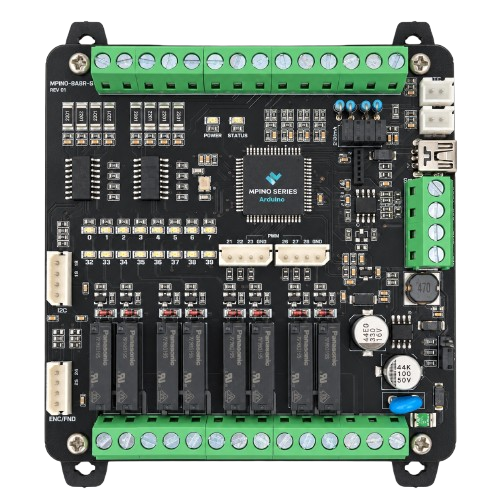 MPINO-8A8R-S: CPU and I/O on one PCB.
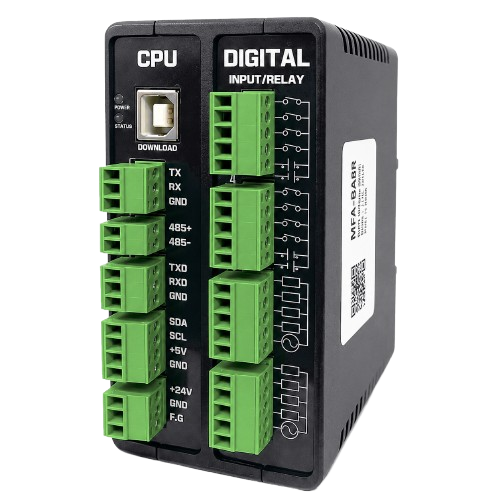 MPAINO-8A8R: a CPU and I/O module configuration.
Use the architecture as a decision gate
If the needed digital, analog and communication functions are already on a particular MPINO board, an integrated model gives you a defined set of terminals and a single model-specific manual to check. That can make the first hardware shortlist straightforward. It does not remove the need to check input ranges, relay ratings, shared commons, pin assignments, power and mounting dimensions for that exact model.
Choose an MPAINO candidate when the required I/O count or mix calls for a documented modular configuration. MPAINO models span eight to 64 digital inputs in the current family comparison, with relay and transistor model variants. The CPU module and I/O modules are selected as a configuration and assembled for shipment; users cannot add or remove the modules themselves. Optional analog, PT100 and pulse-related modules exist, but the exact module combination, available channels and changed pin assignments must be confirmed against the ordered configuration and its documentation.
Do not use a model name as a wiring diagram. For example, the “8A8R” portion identifies an eight-input, eight-relay-output model in both families, but the families have different board layouts and programming connections. The comparison should stop at the model and ordered module level before any terminal, pin or common is assigned.
Check the output and interface before shortlisting
A relay output is a switched contact; a transistor output is an electronic output with a particular polarity and supply arrangement. Match the candidate to the load circuit before looking at channel count. If the requirement calls for a transistor output, compare the corresponding T model, such as MPAINO-8A8T, against its own manual. Do not substitute it for an R model solely because both have eight outputs. Likewise, confirm the input circuit against the sensor’s electrical output; an “isolated digital input” label does not decide every sensor wiring detail.
List the actual devices that need serial communication. MPINO-8A8R-S has RS-485 and I²C in its documented base specification, while MPAINO-8A8R lists RS-232, RS-485, UART and I²C. If a project requires two different physical serial interfaces, this difference matters before software selection. An RS-485 port does not, by itself, prove that the register map, protocol settings or other device will interoperate. Use the Modbus RTU guide for protocol planning, then check both device manuals.
Record the procurement details
Programming accessories also differ. MPINO-8A8R-S uses the dedicated MP Download Cable with a USB-TTL converter built into the cable; an ordinary mini 5-pin USB cable is not a substitute. The MPAINO family specification lists a USB cable and CP210x driver for programming. Check the product page, software download and manual for the exact board before placing the order. Record whether the required cable, module options, sensors and power supply are included or must be ordered separately.
Use this compact worksheet as a review record. Enter each required value beneath its requirement in the first column. The second column lists what to verify, because electrical fit cannot be decided from family labels alone.
| Requirement / your value | What to verify |
|---|---|
| Digital inputs and sensor electrical output ___ | Count, input voltage, sensor type and common wiring in the exact manual |
| Relay outputs ___ | Contact rating, load type and grouping |
| Transistor outputs ___ | Output polarity, supply, current and load circuit in the T-model manual |
| Analog and temperature inputs ___ | Built-in channels or the named ordered module, range and sensor type |
| Serial and I²C interfaces ___ | Physical ports, peer device settings and protocol documentation |
| Power, enclosure and development connection ___ | Supply, dimensions, mounting and required programming cable |
| Configuration and procurement ___ | Exact model, module list, quantity and unresolved questions |
Keep a copy of this table with the model manual and supplier reply so each open item has an owner and a documented answer.
Move from shortlist to a model-specific inquiry
Compare the MPINO series and MPAINO series after completing the worksheet. The existing MPINO-8A8R-S selection guide explains that one integrated model in more detail; the product family comparison lists the broader model range. For MPAINO, the family documentation describes module selection and base pin references.
Send the exact model candidate, I/O list, sensor and load specifications, communication peers, requested modules, programming accessory, quantity, and open questions with your technical inquiry. Ask for confirmation of the ordered configuration before relying on any option-module pinout or installation assumption. That produces a reviewable answer tied to the equipment you are designing, rather than a family-level guess.