
How to choose an Arduino PLC: seven checks and five options
Updated November 13, 2026. Competitor details were checked the same day against each maker's datasheet, product pages and certificates.
An Arduino PLC is a DIN-rail controller you program with Arduino tools, built with field I/O such as 24 V inputs, relay outputs and screw terminals. Pick one by I/O count, input type, network, programming method and certification. Arduino Opta, CONTROLLINO MAXI and MEGA, and M-Duino have Ethernet; ILOGICS MPINO and MPAINO have opto-isolated NPN or PNP inputs on every model and run ladder with Arduino C in one project.
| Arduino Opta | CONTROLLINO MINI / MAXI / MEGA | Industrial Shields M-Duino | ILOGICS MPINO | ILOGICS MPAINO | |
|---|---|---|---|---|---|
| I/O on one unit | 8 inputs, 4 relays | MINI 8 in, 8 out, 6 relays MAXI 12 in, 12 out, 10 relays MEGA 21 in, 24 out, 16 relays | 17 to 58 points by model 19R: 6 inputs, 8 relays, 3 analog outputs | 8 to 16 inputs, 4 to 16 outputs MPINO-16A16R: 16 inputs, 16 relays | From 8 inputs and 8 outputs up to 64 and 64 (MPAINO-64A64R) |
| Adding I/O | Up to 5 expansion modules | Choose a larger model | Choose a larger model, or moduleX I/O over Modbus RTU | Choose a larger model | Choose the point count when you order |
| Digital inputs | Each input digital (0–24 V) or analog (0–10 V) | No galvanic insulation (datasheet) | 19R: 2 opto-isolated (5–24 Vdc) plus 4 analog/digital | Inputs counted in the model name: opto-isolated, NPN or PNP, DC 0–40 V | Inputs counted in the model name: opto-isolated, NPN or PNP, DC 0–40 V |
| Analog and temperature | 0–10 V on the 8 inputs | Voltage on shared inputs. Current-loop and NTC not listed | 19R and 21: 0–10 V inputs and outputs. Their FAQ adds a shunt resistor for 4–20 mA | Analog inputs on every model. MPINO-8A8R-S: 4 inputs (4–20 mA as shipped) and 2 NTC 0–10 V inputs as an order option: MPINO-8A8R-S, MPINO-8A8T-S, MPINO-8A4R-SU, MPINO-16A16R, MPINO-16A8R8T | No analog inputs on the standard models |
| Relay rating | 10 A, 250 VAC | 6 A, 250 VAC or 30 VDC | 19R: 5 A at 250 Vac, 3 A at 30 Vdc | 5 A per point (MPINO-8A8R-S, MPINO-16A16R) | 5 A per point, 8 A per common |
| Ethernet | Every variant | MAXI and MEGA | Every model | None (M-ETHER converter sold separately) | None (M-ETHER converter sold separately) |
| Serial | RS-485 on the RS485 and WiFi variants | RS-485 on MAXI and MEGA | 19R and 21: RS-485 and RS-232 | RS-485 on most models. RS-232 on MPINO-8A4R-S and MPINO-8A4T-S | RS-232, RS-485 and UART |
| Programming | Arduino IDE. Arduino PLC IDE: LD, SFC, FBD, ST, IL | Arduino IDE, PlatformIO, OpenPLC, logi.CAD 3 and others | Arduino IDE with the Industrial Shields boards package | Arduino IDE with the ARDUINO SDK, or MPINO STUDIO2 (ladder and C in one project, free) | Same as MPINO |
| Certifications (maker) | cULus, ENEC, FCC, CE, CB, UKCA | UL Certificate of Compliance (MINI, MAXI, MAXI Automation, MEGA) | CE, RoHS. ETL on M-Duino 21, 42 and 58 | No CE declaration, no UL listing | CE Declaration of Conformity (EMC) for 8A8R, 16A16R, 24A24R, 32A32R and their -X3F2 versions. No UL listing |
| Where to buy in the US | Arduino's online store, including its US store | CONTROLLINO's store and two US distributors | Industrial Shields' shop and a US distributor | ILOGICS online store, PayPal in USD | ILOGICS online store, PayPal in USD |
| Strongest fit | Ethernet or Wi-Fi, IEC 61131-3 languages, cULus | Ethernet, a UL Certificate of Compliance, many digital outputs | Ethernet, SD logging and a clock on board, 0–10 V outputs, ETL models | Isolated NPN or PNP inputs, 4–20 mA and NTC on board, ladder with C | Up to 64 inputs and 64 relays on one controller, ladder with C |
Values come from each maker's datasheet, product pages and certificates, checked November 13, 2026. Each comparison page below lists the details.
Start here: a board with shields, or a finished controller
Many projects start as an Arduino board with an optocoupler board, a relay board and a terminal breakout. That works on the bench. For a machine that ships, every one of those parts needs wiring, a DIN-rail mount and a parts list someone has to rebuild and check for each unit.
An Arduino PLC puts field inputs, relay or transistor outputs, screw terminals and an industrial power input on one DIN-rail board, and the maker supplies the board package for the Arduino IDE. If the machine will be built more than once, or handed to a maintenance team, a finished controller is usually the shorter path.
From a customer
“Personally, I found that the whole package of the MPINO was quite frankly just easier, and offered a surprising amount of functionality and programming flexibility, compared to putting together the BOM for an Arduino, optocouplers, breakout boards, etc.”
Seven checks for choosing an Arduino PLC
1. Count your I/O, then add margin. List every sensor, switch, valve, contactor and lamp. Decide whether you want one controller that already has that many points, or a small base unit plus expansion modules. A board with the full count is simpler to wire and to stock; expansion modules let you change the mix later.
2. Check the input type. Most industrial proximity and photo sensors are NPN or PNP. Check whether the inputs accept both, whether they are opto-isolated, and what voltage counts as ON. Analog inputs differ more: some read 0–10 V only, some read 4–20 mA directly, some take NTC thermistors, and some change range by jumper or by order option.
3. Check the output type and rating. Relays switch AC or DC loads. Transistor outputs switch DC loads faster and without contact wear. Look at the rating per point and per common terminal, because the common decides which loads have to share a supply.
4. Decide on the network. If the controller itself must sit on Ethernet, run Modbus TCP or report to a cloud dashboard, you need an Ethernet port. If it talks to an HMI or other devices over RS-485 with Modbus RTU, a serial port is enough and the wiring is simpler.
5. Decide how you will program and upload it. All of these run Arduino sketches. Beyond that, check for ladder logic and the other IEC 61131-3 languages, and whether ladder and C can live in the same project, so a technician who reads ladder and a developer who writes C can work on one machine. Check how the program gets onto the board: some controllers upload over a plain USB cable, others need a specific programming cable. Check which operating system the tool runs on.
6. Check certification early. If your customer, panel shop or inspector requires UL, cULus, ETL or CE, apply that filter before you compare anything else. It removes options faster than any other check, and the answer can differ between models of the same family.
7. Check how you will buy and get help. Distributor stock in your country, lead time, payment method, how much tutorial and forum material exists, and who answers technical questions all matter once the machine is in the field.
Recommendations by situation
The controller must be on Ethernet or Wi-Fi. Arduino Opta, CONTROLLINO MAXI or MEGA, or an M-Duino. ILOGICS boards have no Ethernet port; the separately sold M-ETHER converter adds Modbus TCP through a serial port.
You need a UL, cULus or ETL certified controller. Arduino Opta (cULus), CONTROLLINO MINI, MAXI or MEGA (UL Certificate of Compliance; check for the UL Mark on the unit), or an M-Duino 21, 42 or 58 (ETL). ILOGICS has no UL listing.
Your team writes structured text or FBD. Arduino Opta with Arduino PLC IDE.
You want ladder for the sequence and C for the math, in one project. MPINO or MPAINO with MPINO STUDIO2. The ladder runs inside your loop() and shares memory with your code, so a technician can follow the rungs while the scaling and protocol code stay in C. The Arduino PLC page shows how a project is laid out.
You have NPN or PNP sensors and want every digital input isolated. MPINO or MPAINO. The digital inputs counted in the model name (8 on an MPINO-8A8R-S, 64 on an MPAINO-64A64R) are all opto-isolated, and NPN or PNP is set by how you wire the common terminal.
You read 4–20 mA transmitters or NTC thermistors. MPINO -S models, such as the MPINO-8A8R-S with 4 analog inputs that read 4–20 mA as shipped and 2 NTC inputs. For M-Duino, the 19R and 21 product pages say to add a shunt resistor to their 0–10 V inputs for a current loop. For 0–10 V transmitters, ILOGICS changes analog inputs to 0–10 V when you order an MPINO-8A8R-S, MPINO-8A8T-S, MPINO-8A4R-SU, MPINO-16A16R or MPINO-16A8R8T.
You need many points on one controller. The MPAINO-64A64R has 64 inputs and 64 relays on one ATmega2560. CONTROLLINO MEGA reaches 21 inputs, 24 digital outputs and 16 relays. Opta grows through expansion modules.
Your HMI talks Modbus RTU over RS-485. Any option with RS-485 works if you write the communication code. MPINO STUDIO2 also has a built-in Modbus RTU slave, so an HMI can read and write ladder memory without communication code. See connecting an HMI.
Each comparison page lists what was checked and where: Arduino Opta alternative, CONTROLLINO alternative and M-Duino alternative.
When a conventional PLC is the better tool
Choose a conventional PLC from an established automation brand when:
the function is safety-related,
the end customer specifies a brand,
your maintenance staff and spare parts are built around one vendor, or
the machine needs hot-swappable rack I/O.
Before using any controller on this page for a safety function, check the maker's safety rating. ILOGICS controllers carry none. For the wider trade-offs, read industrial Arduino vs traditional PLC.
FAQ
What is an Arduino PLC?▾
A DIN-rail controller programmed with Arduino tools and built with industrial I/O: 24 V inputs, relay or transistor outputs, screw terminals and an industrial power input. Some also run ladder logic or other IEC 61131-3 languages.
Can an Arduino PLC run ladder logic?▾
Several can. Arduino Opta runs ladder and four other IEC 61131-3 languages in Arduino PLC IDE. ILOGICS MPINO and MPAINO run ladder in MPINO STUDIO2, in the same project as Arduino C/C++ code. CONTROLLINO lists OpenPLC and logi.CAD 3 among its compatible tools.
Which Arduino PLC has the most I/O on one unit?▾
Among the options here, the ILOGICS MPAINO-64A64R has 64 inputs and 64 relay outputs on one controller. Industrial Shields lists M-Duino models from 17 to 58 points, and Arduino Opta reaches higher counts by adding expansion modules to an 8-input base unit.
Which Arduino PLCs are UL or ETL certified?▾
Arduino lists cULus for Opta. CONTROLLINO publishes a UL Certificate of Compliance for MINI, MAXI, MAXI Automation and MEGA. Industrial Shields lists ETL for the M-Duino 21, 42 and 58. ILOGICS has no UL or ETL listing.
Do Arduino PLCs have Ethernet?▾
Arduino Opta, CONTROLLINO MAXI and MEGA, and every M-Duino do. ILOGICS MPINO and MPAINO boards do not; they use RS-485, RS-232, UART and I²C. For a Modbus TCP network, the separately sold M-ETHER converter links an RS-232 or RS-485 port to Ethernet.
Can an Arduino PLC read 4–20 mA sensors directly?▾
Some can. The ILOGICS MPINO-8A8R-S analog inputs read 4–20 mA as shipped. On that model and four other MPINO models, ILOGICS changes analog inputs to 0–10 V when you order. The M-Duino 19R and 21 inputs read 0–10 V, and their product pages suggest a shunt resistor for a current loop. Check the analog input range in each datasheet before you choose.
Related
Controllers covered
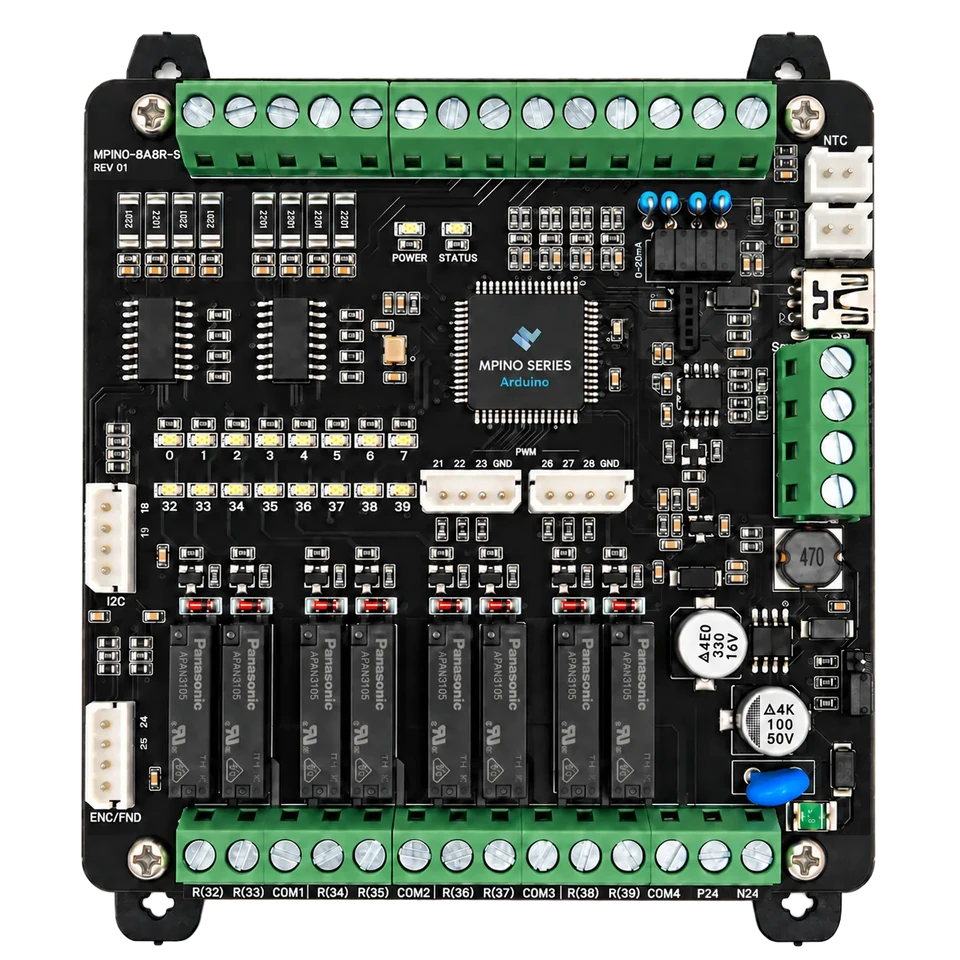
MPINO-8A8R-S
MPINO-8A8R-S Industrial Arduino Controller
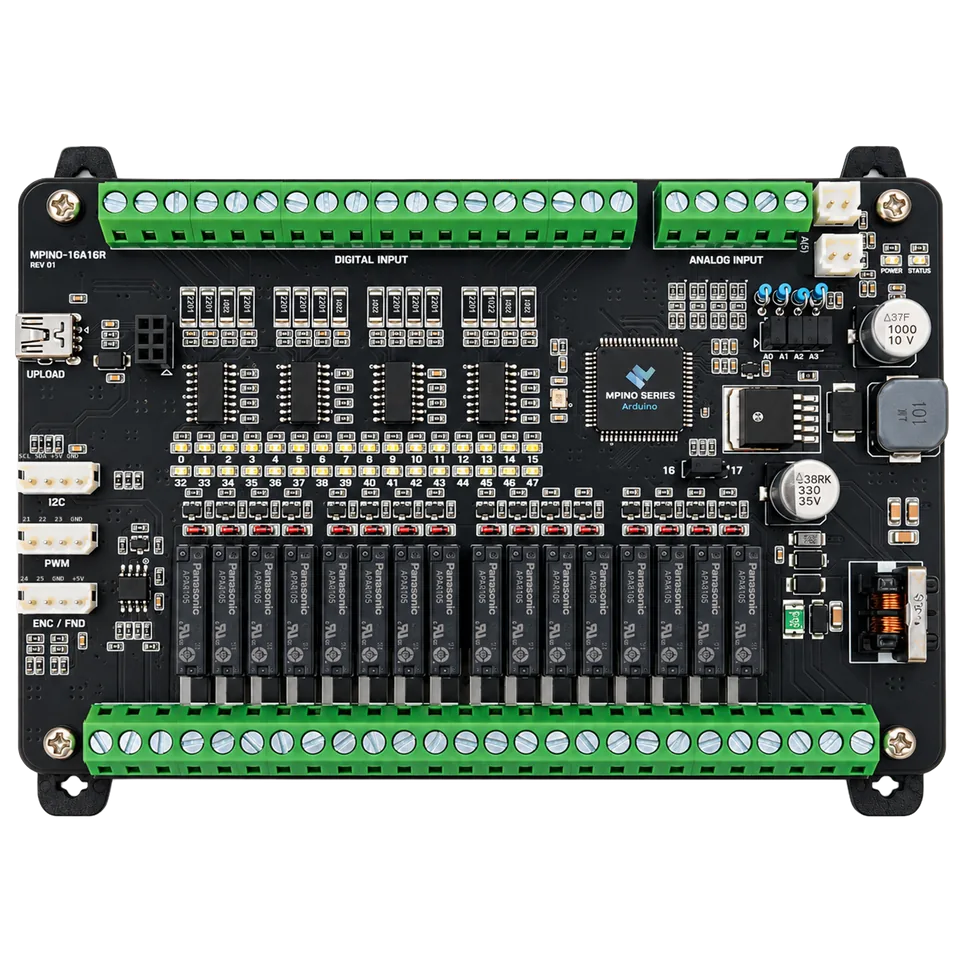
MPINO-16A16R
MPINO-16A16R Industrial Arduino Controller
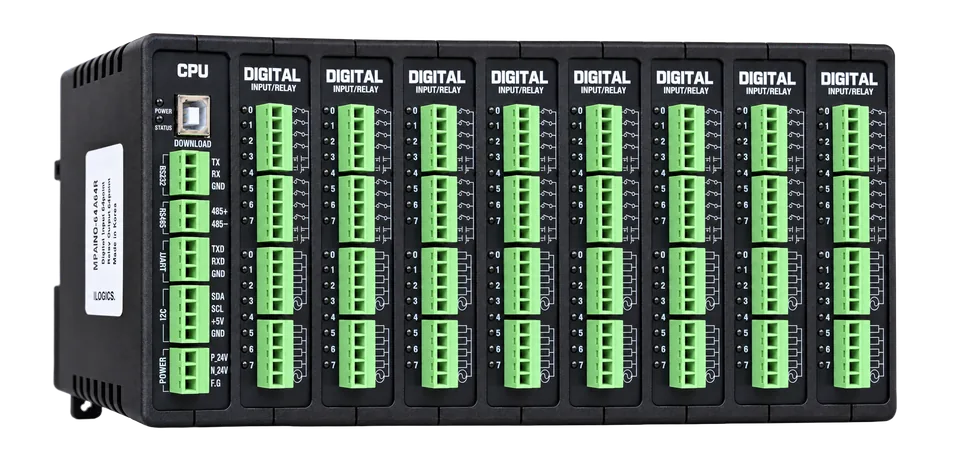
MPAINO-64A64R
MPAINO-64A64R Industrial Arduino Controller
Arduino, Opta, CONTROLLINO, Industrial Shields and M-Duino are trademarks of their respective owners. They are named here only to identify products for comparison. ILOGICS is not affiliated with any of these companies.