
Arduino Opta alternative: MPINO and MPAINO compared
Competitor details checked November 13, 2026, against Arduino's Opta datasheet, the Opta product page and the Arduino PLC IDE documentation.
Arduino Opta is a micro PLC with Ethernet on every variant, a 480 MHz Cortex-M7 and all five IEC 61131-3 languages. ILOGICS MPINO and MPAINO put up to 64 opto-isolated inputs and 64 relays on one controller (MPAINO-64A64R), and the free MPINO STUDIO2 keeps ladder logic and Arduino C/C++ in one project. Choose Opta when you need Ethernet, structured text or cULus certification.
| ILOGICS MPINO-8A8R-S | Arduino Opta (Lite, RS485, WiFi) | |
|---|---|---|
| Processor | ATmega128, 16 MHz | STM32H747XI: Cortex-M7 up to 480 MHz plus Cortex-M4 up to 240 MHz |
| Digital inputs | 8, opto-isolated, NPN or PNP, DC 0–40 V, ON at DC 5 V and above | 8, each used as a digital input (0–24 V) or an analog input (0–10 V) |
| Relay outputs | 8, 5 A per point, AC 0–250 V or DC 0–30 V | 4, normally open, 10 A each, 250 VAC |
| Analog and temperature | 4 analog inputs (4–20 mA as shipped, 0–5 V by jumper, 0–10 V as an order option) and 2 NTC inputs | The 8 inputs double as 0–10 V analog inputs, 12 to 16 bits |
| More I/O | Choose a larger board: MPINO-16A16R (16 inputs, 16 relays) or MPAINO, up to 64 inputs and 64 relays | Up to 5 expansion modules per unit |
| Ethernet | None on the board. The M-ETHER converter is sold separately | 10/100 on every variant, with Modbus TCP |
| Serial and wireless | RS-485 (Modbus RTU master or slave) and I²C | RS-485 on the RS485 and WiFi variants. Wi-Fi and Bluetooth LE on the WiFi variant |
| Programming | Arduino IDE with the ARDUINO SDK, or MPINO STUDIO2 (ladder and Arduino C/C++ in one project, free, Windows) | Arduino IDE, or Arduino PLC IDE with LD, SFC, FBD, ST and IL (Windows, free download) |
| Upload | MP Download Cable, sold separately | USB-C |
| Supply | DC 12–24 V | 12–24 VDC |
| Certifications | No CE declaration and no UL listing for MPINO models | cULus, ENEC, FCC, CE, CB, UKCA |
| Where to buy in the US | Direct from the ILOGICS online store, PayPal in USD. No US distributor | Arduino's online store, including its US store |
| Choose it when | You want 8 or more relays and isolated NPN or PNP inputs on one board, 4–20 mA and NTC inputs on the controller, and ladder with C in one project | You need Ethernet or Wi-Fi, structured text or FBD, Cortex-M7 headroom, or a controller with cULus certification |
Opta values come from Arduino's Opta datasheet, checked November 13, 2026. ILOGICS values come from the MPINO-8A8R-S documentation.
Inputs and relays per unit
The Opta base unit has 8 inputs and 4 relay outputs. An MPINO-8A8R-S has 8 inputs and 8 relays, and carries 4 analog inputs and 2 NTC temperature inputs on the same board. If the machine needs 16 inputs and 16 relays, the MPINO-16A16R handles them on one board. One MPAINO-64A64R carries 64 inputs and 64 relay outputs.
Opta grows by adding expansion modules, up to five per unit, so the base stays small, and Arduino documents both digital and analog expansion modules for it. With MPINO you pick the board that already has the count you need. With MPAINO you pick the point count when you order, from 8 inputs and 8 relays up to 64 and 64.
Input wiring: NPN, PNP or 0–10 V
On every MPINO and MPAINO, the digital inputs counted in the model name (the 8 in MPINO-8A8R-S) pass through an optocoupler. Some models also have a few 5 V high-speed or interrupt pins, which are not isolated. On the MPINO-8A8R-S all eight inputs share one common terminal, and the common decides the sensor type. Connect it to 0 V when the sensor drives DC 5–24 V into the input (PNP). Connect it to DC 5–24 V when the sensor pulls the input to 0 V (NPN). Inputs accept DC 0–40 V and read ON at DC 5 V and above.
Opta's inputs are flexible in another way. Each of the eight can be set as a digital input or as a 0–10 V analog input with 12 to 16 bits of resolution. If most of your sensors are 0–10 V transmitters, that may matter more to you than NPN or PNP wiring.
On MPINO, 0–10 V is an order option for the analog inputs of the MPINO-8A8R-S, MPINO-8A8T-S, MPINO-8A4R-SU, MPINO-16A16R and MPINO-16A8R8T. ILOGICS changes the inputs before shipping.
Ladder and Arduino C in one project
Both platforms run Arduino sketches and both offer ladder logic. For ladder, Opta uses Arduino PLC IDE, a free Windows download that supports all five IEC 61131-3 languages: ladder (LD), sequential function chart (SFC), function block diagram (FBD), structured text (ST) and instruction list (IL). If your team writes structured text today, Opta is the closer match.
ILOGICS uses MPINO STUDIO2, a free Windows tool for every MPINO and MPAINO model. One project file holds ladder tabs and Arduino C/C++ code tabs. The ladder becomes a C function, ladderLoop(), that your loop() calls, and both sides read and write the same PLC memory: P, M, D, T, C and R. A technician can watch contacts and coils in ladder monitoring while the scaling math and protocol code stay in C.
STUDIO2 also includes a Modbus RTU slave and an LS Cnet slave, so an HMI on the RS-485 port can read and write that memory without communication code in your sketch. Since version 2.2.0, timer and counter presets can come from D memory, so an operator can change a delay from the HMI. STUDIO2 does not offer structured text, FBD, SFC or IL. If you need those, choose Opta.
Ethernet, Wi-Fi and Arduino Cloud
Opta wins this one. Every variant has 10/100 Ethernet with Modbus TCP, the WiFi variant adds Wi-Fi and Bluetooth LE, and Arduino documents a connection to Arduino Cloud dashboards.
No MPINO or MPAINO board has an Ethernet port. They communicate over serial lines: RS-485 with Modbus RTU on most models, RS-232 on the MPINO-8A4R-S and MPINO-8A4T-S, and RS-232, RS-485 and UART on every MPAINO. For a Modbus TCP network, the separately sold M-ETHER converter links an RS-232 or RS-485 port to Ethernet. If the controller itself has to sit on Ethernet or report to a cloud dashboard, Opta is the simpler path.
Processor headroom
Opta's dual-core STM32H747XI is far faster than the 8-bit AVR chips in MPINO and MPAINO (ATmega128 or ATmega2560). For predictive-maintenance algorithms, heavy floating-point math or large data sets, Opta has headroom an 8-bit controller does not. An 8-bit AVR handles sequencing, interlocks, timers, counters and Modbus polling.
Certification, buying and support
Arduino's datasheet lists cULus, ENEC, FCC, CE, CB and UKCA for Opta. ILOGICS publishes a CE Declaration of Conformity under the EMC Directive for MPAINO-8A8R, MPAINO-16A16R, MPAINO-24A24R and MPAINO-32A32R, their -X3F2 versions and the matching MPA ladder PLCs. No MPINO model is covered, and no ILOGICS board carries a UL listing. If your customer, panel shop or inspector requires a controller with UL or cULus certification, choose Opta.
Arduino sells Opta in its own online store, which includes a US store. ILOGICS has no US distributor. It sells direct from its online store with PayPal checkout in USD and ships from Korea. Orders of 10 units or more go through the quote form, and a quoted order can also be paid by prepaid bank transfer in USD. ILOGICS boards carry a one-year warranty from the delivery date, and engineers answer technical email on weekdays, 09:30–17:30 Korea time.
From a customer
“I couldn't find much info anywhere else (forums, YouTube, etc.), but I pulled the trigger and bought one of your controllers, and I'm happy I did. I am very impressed with your controller and software ecosystem.”
When Arduino Opta is the better choice
The controller must be on Ethernet, Wi-Fi or Arduino Cloud.
Your team programs in structured text, FBD or SFC.
The project needs a controller with cULus certification.
You need the processing power of a Cortex-M7.
You want to buy from a store or distributor in the United States.
You want Arduino's community and learning material, such as the Arduino Forum, Project Hub and the free ACE-100 Opta course.
When MPINO or MPAINO is the better choice
You want more relays and inputs on one board, without expansion modules.
Your sensors are NPN or PNP and every digital input should be opto-isolated.
You read 4–20 mA transmitters and NTC thermistors on the controller itself (MPINO-8A8R-S).
You want ladder and Arduino C/C++ in one project, in a free tool.
The machine needs 32, 48 or 64 inputs on one controller (MPAINO).
Your HMI talks Modbus RTU over RS-485.
Moving a sketch or PLC IDE project from Opta
Plain Arduino logic carries over: digitalRead(), digitalWrite(), millis() and your state machines. Pin numbers, the analog setup and the communication code change. MPINO boards need analogReference(EXTERNAL) in setup() for correct analog readings, and the serial port behind RS-485 differs between models (Serial1 on the MPINO-8A8R-S, Serial2 on the MPINO-8A8R), so check the model manual first. Opta libraries for Ethernet, Wi-Fi, expansion modules and Arduino Cloud have no MPINO equivalent.
Ladder written in Arduino PLC IDE has to be redrawn in MPINO STUDIO2. The MPINO STUDIO2 manual walks through a first project, the memory types and ladder editing. The MPINO-8A8R-S uploads through the MP Download Cable, which has the USB-to-serial converter built in; a plain USB cable will not upload.
FAQ
Is MPINO a drop-in replacement for Arduino Opta?▾
No. The I/O count, pin map and communication ports are different, and MPINO has no Ethernet port. Plain Arduino logic carries over, but pin assignments and communication code need rework, and Arduino PLC IDE projects have to be redrawn in MPINO STUDIO2.
Can MPINO run ladder logic like Arduino Opta?▾
Yes. MPINO STUDIO2 runs ladder on every MPINO and MPAINO model, in the same project as Arduino C/C++ code, and it is free. It does not offer structured text, FBD, SFC or IL, which Arduino PLC IDE does.
Which has more relay outputs per unit, Opta or MPINO?▾
The Opta base unit has 4 relays and adds more through expansion modules. MPINO-8A8R-S has 8 relays, MPINO-16A16R has 16, and MPAINO-64A64R has 64 on one controller.
Does any ILOGICS controller have Ethernet?▾
No MPINO or MPAINO board has an Ethernet port. They use RS-485, RS-232, UART and I²C, depending on the model. For a Modbus TCP network, the separately sold M-ETHER converter links an RS-232 or RS-485 port to Ethernet.
Are ILOGICS controllers UL listed?▾
No. ILOGICS publishes a CE Declaration of Conformity under the EMC Directive for MPAINO-8A8R, MPAINO-16A16R, MPAINO-24A24R and MPAINO-32A32R, their -X3F2 versions and the matching MPA ladder PLCs. MPINO models are not covered. Arduino lists cULus for Opta.
Related
- MPINO-8A8R-S — 8 inputs, 8 relays, 4 analog, 2 NTC, RS-485
- MPINO-16A16R — 16 inputs, 16 relays on one board
- MPAINO-64A64R — 64 inputs, 64 relays on one controller
- M-ETHER — Ethernet to RS-232 or RS-485 converter
- MPINO series
- Arduino PLC with ladder logic and Arduino C
- MPINO STUDIO2 download
- MPINO STUDIO2 manual
- How to choose an Arduino PLC
- Request a quote
Controllers covered
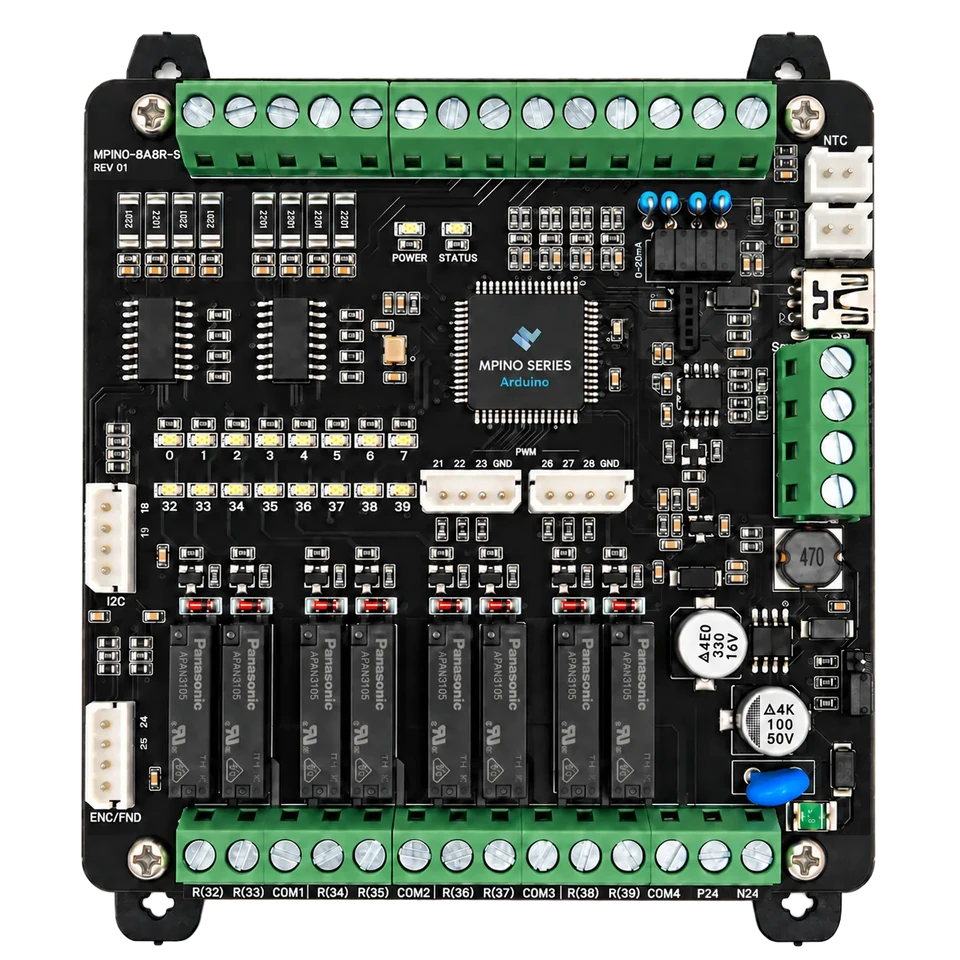
MPINO-8A8R-S
MPINO-8A8R-S Industrial Arduino Controller
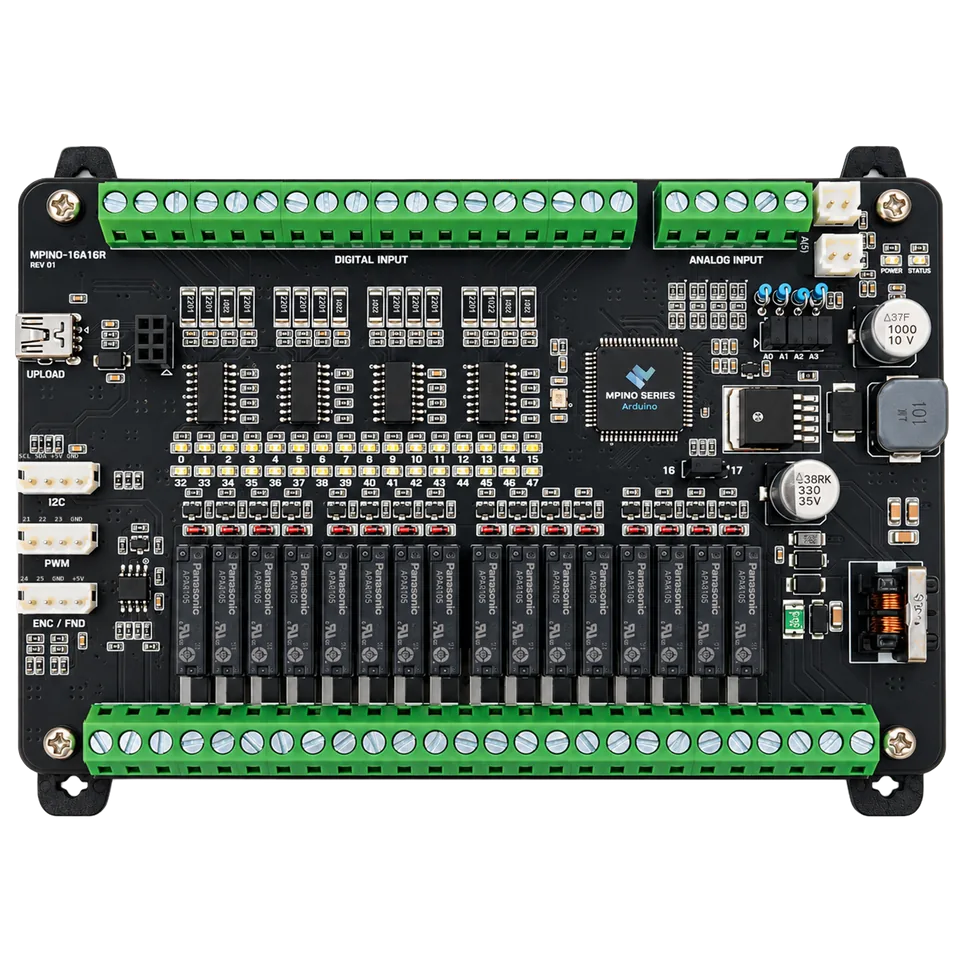
MPINO-16A16R
MPINO-16A16R Industrial Arduino Controller
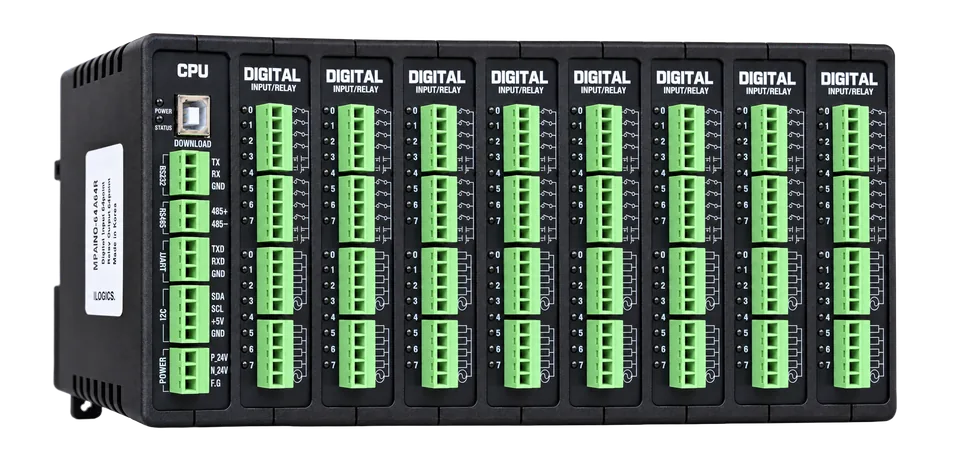
MPAINO-64A64R
MPAINO-64A64R Industrial Arduino Controller
Arduino and Opta are trademarks of their respective owners. They are named here only to identify products for comparison. ILOGICS is not affiliated with Arduino or Finder.